The Small Detail That Brings a Memory into Focus
Learn how one concrete detail can bring a memory into focus, and use a simple prompt to recall what you know without inventing missing parts.
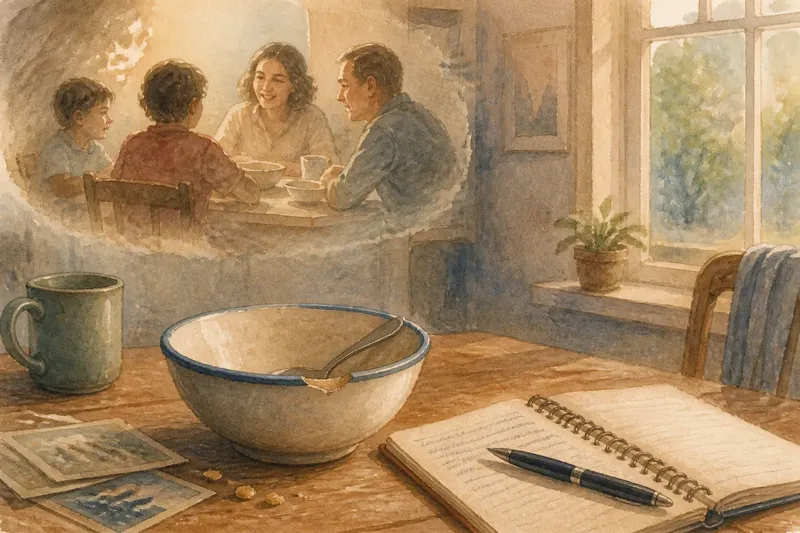
You remember the chipped blue rim of a cereal bowl, but not what anyone said across the kitchen table. A small detail like that can bring a memory into focus without requiring you to fill its silent spaces. In personal storytelling, the value of a detail lies not in how vivid it sounds, but in how honestly it connects you to what you recall.
What does a small detail do for a memory?
A concrete detail gives a reader somewhere to stand. The bowl’s rough rim, a damp sleeve, or the smell of oranges on someone’s hands can make a recollection feel situated in a particular room and moment.
It also gives the writer a manageable point of attention. A memory may arrive as a tangle of feelings and uncertain fragments; noticing one object or sensation can help you describe what is actually present in your recollection, rather than reaching for a complete scene you cannot reliably reconstruct.
Think of the detail as a door handle, not the whole house. It helps you enter the scene, but it does not tell you what every room looked like.
Which details are most useful to remember?
The most useful detail is usually the one you can recall with some specificity. It might be material, sensory, or tied to a small action:
- Texture: the scratch of a wool coat against your chin.
- Sound: a screen door tapping its frame.
- Smell or taste: wet pavement after rain, or the bitter edge of grapefruit.
- Appearance: a cracked green mug beside the sink.
- Movement: someone turning a paper napkin over and over.
Specificity need not mean ornate description. “A mug” identifies an object; “the cracked green mug” offers a clearer anchor. If the color or crack is uncertain, leave it out. A plain, accurate noun is more useful than a polished detail that has drifted into guesswork.
How can you tell a remembered detail from an inferred one?
A remembered detail feels connected to your recollection itself: you can picture, hear, feel, or otherwise call it to mind. An inference is something you supply because it seems likely. You may remember sitting near a window without knowing whether the curtains were open.
Try separating what you recall from what you assume. Write the detail in a private note, then ask: “Do I remember this, or does it merely fit the scene?” If the answer is uncertain, describe that uncertainty or omit the detail. You can also anchor the prose in your own perspective: “I remember the window beside me, though not whether the curtains were drawn.”
This distinction matters because readers often treat confident sensory description as a claim about what happened. A candid limit can make a passage more trustworthy without making it less affecting.
How do you find one detail without inventing the gaps?
Choose a specific memory and give yourself a quiet moment to attend to what comes readily. Do not begin by demanding a full scene. Start with one question at a time, and keep a clear line between recall and possibility.
- Name the moment in a few words, such as “waiting in the school office.”
- Ask what object, surface, sound, smell, or physical sensation you remember.
- Write the first concrete detail that comes to mind, using simple language.
- Mark anything uncertain with a note to yourself rather than turning it into fact.
- Draft a couple of sentences around the remembered detail, staying within what you can honestly claim.
Say you remember sitting in a school office and can still picture a brass clip on the corner of a form, but cannot recall what the receptionist wore. You might write, “The form had a brass clip that caught the light when I moved it. I don’t remember what the receptionist looked like.” The result is a scene with a tangible point of focus and an openly acknowledged blank.
Why can a modest detail carry more feeling than a dramatic one?
A small object or gesture can hold emotional meaning without explaining that meaning for the reader. The way a person sets down a spoon, folds a receipt, or smooths a tablecloth may be more revealing than a broad statement about tension or affection—provided you genuinely remember the action.
That restraint also protects the balance of a scene. If every sentence announces what an event meant, the sensory detail can begin to feel like decoration. Let the image remain itself, then consider what it suggests to you now. Keep the distinction clear between the remembered action and your present interpretation of it.
Should you use a detail that came from a photograph or family story?
You can use information from a photograph, letter, or another person’s account, but identify its source in your own thinking and, where useful, in the writing. Seeing a striped curtain in an old photograph is not the same as remembering it from the room. A relative’s account may add context, but it does not become your personal recollection simply because you heard it often.
These sources can still help you shape an honest passage. You might write, “In the photograph, a striped curtain hangs behind us,” or “My sister remembers the kitchen radio playing.” Such phrasing lets readers know what you saw or were told, without blending it into sensory memory.
When should you leave a vivid detail out?
Leave it out when you cannot tell whether you remember it or have supplied it, when it belongs to someone else’s account, or when it distracts from the moment you are trying to convey. A striking image is not automatically a reliable one.
When you revise, check whether each detail is grounded in your own recollection, another identified source, or an explicit uncertainty. The small detail that brings a memory into focus earns its place by helping you see what you truly remember—not by making the past seem more complete than it is.