The Perfect Ending Is Not Required
Personal story endings can close on a vivid scene or honest uncertainty, helping your draft feel complete without forcing a lesson onto the memory.

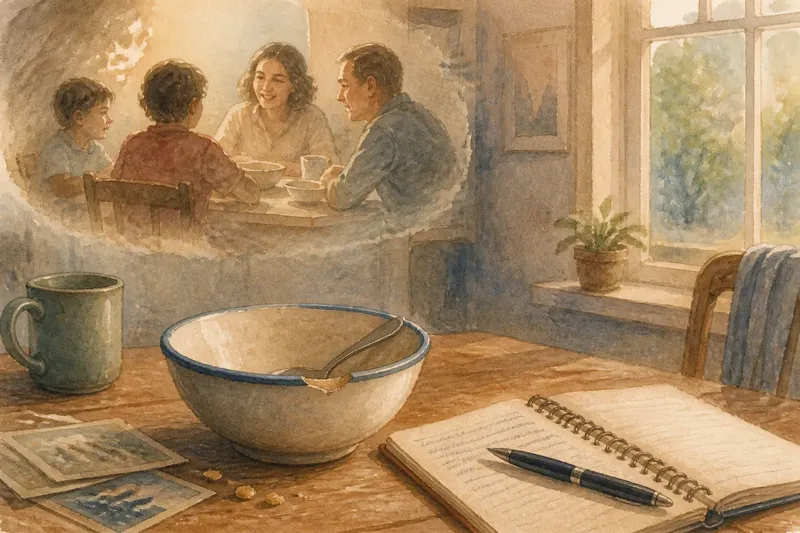
At the kitchen table, a writer rereads the last paragraph of a story about her brother moving away. The final line says, “I learned that people we love must be allowed to find their own way,” but it sounds more polished than the memory itself. A personal story ending does not have to explain what the story means.
Imagine Mara, an invented writer in a hypothetical situation, revising that draft. She remembers a tense conversation, a half-packed box, and the quiet work of clearing a shelf after her brother leaves their shared apartment. She wants the story to be fair to him without pretending she has settled every feeling.
A neat lesson can overstate what the narrator knows
Mara’s sentence about letting people find their own way may be true in general, but the story has not shown that understanding arriving. It shifts from the particular apartment and its strained silence to a broad claim that could belong at the end of many stories.
She asks what the final line is doing. If it reflects something she genuinely understands, it may belong; if it mainly makes the experience easier to summarize, it may be covering uncertainty instead of expressing it.
That uncertainty need not erase what is clear. Mara knows her brother chose to leave and that she felt hurt afterward. She does not have to choose between affection and resentment, or turn either feeling into the story’s only truth.
Locate the moment where the story’s movement changes
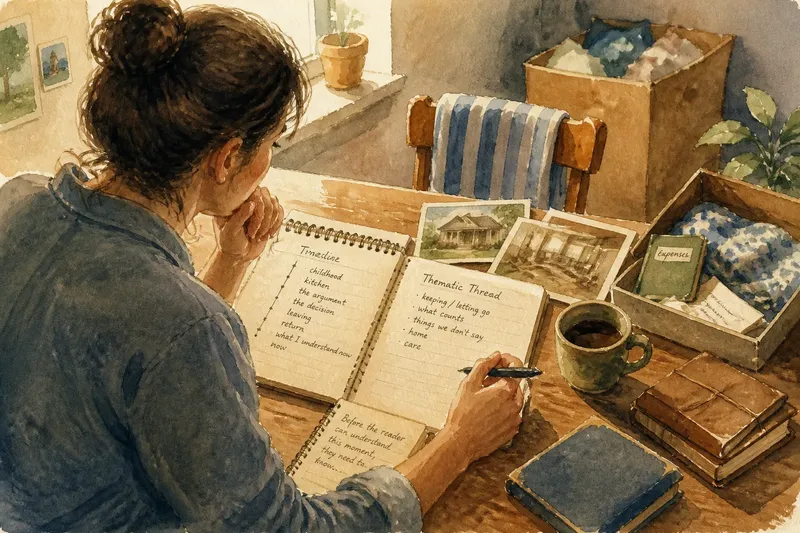
Before rewriting the ending, Mara marks the last moment when the scene changes direction. The argument and decision to leave carry one kind of tension; afterward, the narrator has to face the ordinary tasks left behind. That shift may offer a more natural stopping point than a statement about what the experience taught her.
She reads the final pages aloud and notices that the prose slows when she describes clearing the shelf. Rather than add a dramatic gesture, she gives that quieter moment room. The scene’s pace, not an added moral, can signal that the story is nearing its end.
This approach works with many kinds of memories. A conversation may end with a pause neither person fills, or a journey may close with the narrator putting away an object brought home. The useful question is whether the moment belongs to the story’s actual sequence, not whether it looks symbolic from a distance.
Choose between a concrete scene and an honest uncertainty
Mara tries two different endings. In the first, she describes setting the cleared shelf back in order and stopping at the empty space where her brother’s books had been. In the second, she writes that she still cannot tell whether the emptiness felt like relief or loss that evening.
The scene version leaves the reader with something visible. The reflective version makes the narrator’s limited understanding explicit. Neither is automatically stronger; each creates a different kind of closing note.
To compare them, Mara reads the paragraphs before each final line. The scene ending feels earned because the story has stayed close to the apartment and its details. The uncertainty fits because the draft has traced her attempts to interpret her brother’s decision. She keeps the version that best matches the story’s established focus, rather than combining both and explaining the choice afterward.
A concrete scene is not a coded message that needs decoding. An unresolved thought is not an excuse to withhold information the narrator can provide. Like placing a bookmark between pages, either choice can mark a pause without claiming the whole story has been settled.
Revise the last paragraph with specific decisions
Mara makes a focused pass through the final pages. She checks what the draft has actually established, tries alternatives, and decides what to keep based on the result:
- Mark the last active moment. If a gesture, decision, or observation changes the scene’s direction, test it as the ending; if nothing changes there, move the marker to the last meaningful turn.
- Underline any lesson sentence. If earlier scenes support its claim, keep it in the narrator’s natural voice; if they do not, cut it or narrow it to what the narrator can honestly say.
- Draft a scene-based ending. If a concrete action or detail already appears in the story, use it to close the scene; if the detail needs a new explanation to seem meaningful, choose another moment.
- Draft an uncertainty-based ending. If the narrator genuinely does not know what a particular action meant, state that limit; if the question asks for information the draft can answer, supply the information instead.
- Read both versions aloud. If one sounds consistent with the narrator’s established voice, keep it for the next pass; if neither does, revise the wording before judging the ending.
- Check the final claim’s reach. If it stays within what the narrator experienced and knows, let it stand; if it turns one memory into a rule for everyone, narrow or remove the claim.
In Mara’s invented revision, the starting draft ends with a general lesson after the brother’s departure. She marks the later scene of clearing the shelf, then writes the two alternatives described above and reads each beside the preceding paragraph. The empty-space version matches the story’s physical focus, while the question about relief and loss makes its reflection more explicit; she chooses the scene because it closes the events without claiming to resolve her feelings.
What should the final line leave with the reader?
Does a personal story need to end with a lesson?
No. A lesson belongs when it grows from the scenes and reflects what the narrator understands. If it sounds more certain or general than the story, a scene or a carefully stated uncertainty may fit better.
How can I tell whether an ending detail feels forced?
Check whether the detail belongs to the events and whether the story has prepared the reader to notice it. If it needs a grand explanation to seem important, return to a moment with a clearer connection to the story’s movement.
Can a personal story end with a question?
Yes, when the question names a genuine uncertainty rather than withholding information the narrator could provide. Keep it tied to a particular memory or decision instead of widening it into a question about life in general.
What if the ending still feels unresolved?
Separate the story’s movement from the narrator’s interpretation. If the events and their immediate consequences have been rendered clearly, an unanswered feeling may be an honest ending; if an important event remains unclear, revise the scene before settling the last line.
Let the ending stop at the edge of the memory
Mara removes the polished lesson because it promises more certainty than her draft contains. The story can close on the cleared shelf, or on her uncertainty about what that evening meant, without deciding that one feeling cancels the other.
When revising a personal story ending, ask whether the last line belongs to this narrator, this memory, and the knowledge available in the scene. A useful ending may offer a clear pause while leaving interpretation open; its restraint can be more truthful than a tidy answer.