A Low-Clutter Session for Sorting Family Story Fragments
Sort family story fragments into keep, check, and set-aside groups while preserving useful memories, tracking uncertainty, and keeping a session focused.
You spread a few handwritten notes across the kitchen table: a remembered trip, a cousin’s correction, a date with a question mark. Sorting family story fragments does not require a wall of sticky notes or an immediate decision about what the family should publish. A focused paper session can separate recollections worth carrying forward from details that need checking and material best left aside for now.
Set a boundary before the papers spread
Clutter often starts because the task has no edge. One note leads to a photo album, then to a text thread, then to a fresh story someone tells while you are looking for a date. Each item may matter, but pulling everything in at once makes it hard to judge any one fragment.
Choose a single story question for the session, such as what the family remembers about a move, a holiday meal, or a relative’s workshop. Gather only notes connected to that question. Use one sheet of paper for your working list, three labeled areas on the table, and a pen; a shoebox lid can serve as a tray if the table is shared.
Set a stopping point before you begin: stop when every fragment in the chosen group has a place, not when every family memory has been collected. This is a sorting session, not an attempt to settle the whole account. Think of the three groups as trays beside a doorway: they hold material temporarily while you decide what to carry into the next room.
Use three groups that preserve uncertainty
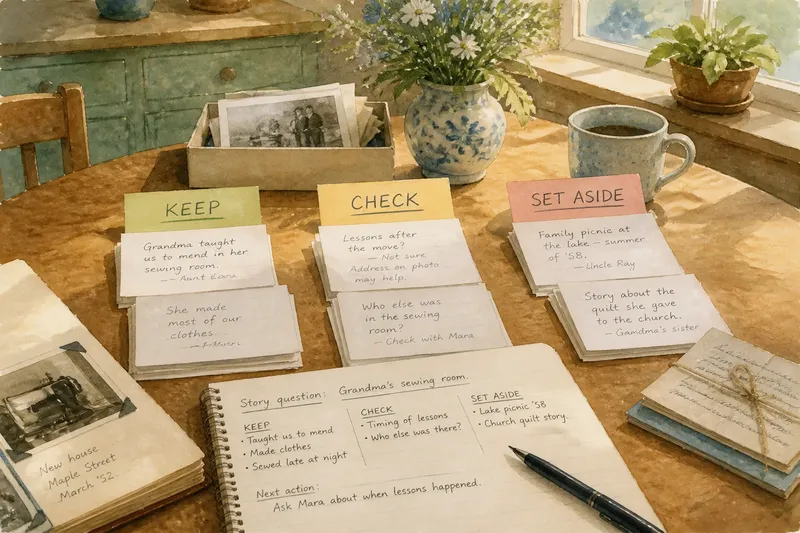
Label the groups Keep, Check, and Set aside. “Keep” means the fragment currently belongs in the working pile, not that every detail is settled or that it must appear in a final version. “Check” holds details that could alter the account if they prove different. “Set aside” is for material that may be interesting but does not serve this story question, or that you do not yet have a good reason to share.
Write each recollection on its own slip of paper, or give each separate note a clear line on the working sheet. Keep its source attached: “Aunt Lena remembers…” or “Note from the blue album.” That small phrase distinguishes a remembered account from a confirmed date and prevents a family member’s voice from disappearing into an anonymous statement.
Do not turn the groups into a ranking of people’s memories. A fragment can be sincere and still uncertain; another person’s disagreement does not automatically make it useless. The labels describe what to do with the material, not whose memory deserves belief.
Decide where each fragment belongs
For each note, ask what it contributes to the chosen story, what remains uncertain, and whether it belongs in this account at all. The point is not to settle every disagreement at the table; it is to make the next action clear.
Keep a fragment that serves the story
Keep a fragment when it clearly connects to the chosen story and you can name what it contributes: a decision someone made, a relationship, a change in circumstances, or a detail that helps explain why an event mattered. If its role is still vague, move it to Check or Set aside rather than keeping it merely because it is vivid.
Check details that could change the account
Use Check for a claim whose uncertainty could alter the story, such as who was present, what happened first, or whether two relatives are describing the same occasion. Write down the precise question and a plausible source for an answer, such as a labeled photograph, a letter, or a conversation with someone who was there.
Set aside material that does not fit this pass
Set a fragment aside when it leads away from the story question, repeats something already represented, or includes personal material you are not ready to consider for sharing. Keep the slip rather than crossing it out; a different account may need it later, and postponing a choice is not the same as denying the memory.
Keep differing accounts distinct
If relatives remember the same event differently, record who remembers each version without blending them into one confident claim. When the disagreement concerns a detail that is not central, mark it for checking or leave it unresolved rather than letting it consume the session.
Make checking specific without turning it into a hunt
A vague note such as “verify the whole story” invites another sprawling search. Turn each Check slip into a small question: “Does the back of this photograph identify the house?” or “Can Mara say whether the visit came before the move?” Then record the possible source beside it. The note should tell you what answer would help, not send you searching through every family record.
Imagine you are sorting notes about a grandmother’s sewing room. One slip says she taught two grandchildren to mend; another says the lessons happened after a particular move, but the writer is unsure. Keep the teaching memory if it fits the account, put the timing in Check with the address written on a photograph as a possible clue, and set aside an unrelated story about a later family picnic. The resulting working pile preserves the central recollection while leaving its uncertain timing open.
Before consulting another relative, phrase the question so it does not suggest the answer you hope to hear. “What do you remember about when the sewing lessons happened?” leaves room for their account; “They were after the move, right?” can steer it. If a label, family record, or local rule affects what can be shared, follow the relevant guidance and keep the sorting itself focused on the material.
Leave a clear record of the decisions
At the end, copy the useful outcome onto the working sheet: the story question, the fragments in Keep, the exact questions in Check, and the material set aside. Note who supplied a recollection wherever that matters. Leave yourself a brief next action, such as asking one relative about one point or rereading a letter already identified as relevant.
Put the Set aside slips in an envelope or folder marked with the story question, rather than returning them to an undifferentiated stack. Keep and Check can go together in a thin folder, with their labels still visible. This modest paper trail makes it easier to resume without reopening every album and message.
A low-clutter session for sorting family story fragments succeeds when it leaves fewer loose decisions, not when it produces a polished family narrative. Keep the categories provisional: a checked detail may change its place, and a fragment set aside today may fit a later story. When you return to the papers, begin with the next clear question, not with pressure to make every memory agree.